WireBadger
Malicious Cable Detector
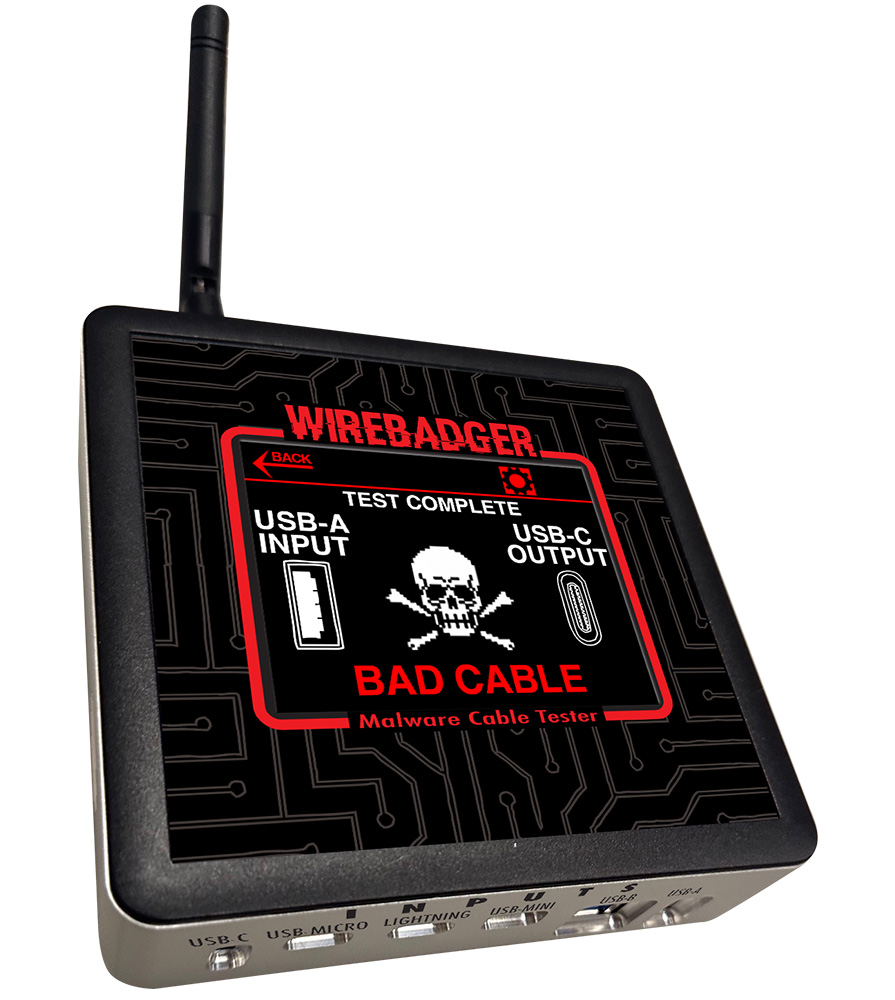
WireBadger™ is a self-contained cable tester that checks for embedded malicious hardware in all popular USB and Lightning cable standards. As soon as any cable is plugged in, WireBadger automatically checks for subtle current draw and wireless hotspots attributed to malicious keyloggers, payloads and attacks that derive from cables. WireBadger checks the following cables: USB-A, USB-B, USB-C, USB-Mini, USB-Micro and Lightning as well as embedded Wi-Fi and Bluetooth devices.
WireBadger™ is a self-contained cable tester that checks for embedded malicious hardware in all popular USB and Lightning cable standards. As soon as any cable is plugged in, WireBadger automatically checks for subtle current draw and wireless hotspots attributed to malicious keyloggers, payloads and attacks that derive from cables. WireBadger checks the following cables: USB-A, USB-B, USB-C, USB-Mini, USB-Micro and Lightning as well as embedded Wi-Fi and Bluetooth devices.
USB technology was designed for convenience and universal compatibility. When a cable or device connects, computers and mobile devices automatically trust and communicate with it — often without user approval. This built-in trust has created a major cybersecurity risk, allowing attackers to transform ordinary-looking USB cables into powerful attack tools.
Modern malicious USB cables contain embedded microcontrollers that can impersonate trusted devices, execute commands, install malware, modify system settings, or exfiltrate sensitive data. Unlike traditional threats, these hardware-based attacks operate at the protocol level, frequently bypassing antivirus software and endpoint protection.
Early threats such as BadUSB and Cottonmouth demonstrated how firmware-level modifications could weaponize USB devices without exploiting software vulnerabilities. Today’s attack cables are smaller, cheaper, and more advanced, targeting laptops, desktops, mobile devices, and embedded systems across USB-A, USB-C, and Lightning connectors. Some variants even include wireless control for remote activation.
Risk increases through everyday behavior such as borrowing chargers, using promotional cables, or connecting to public charging stations. Security agencies — including the NSA — warn against untrusted USB accessories due to the growing threat of hardware-based attacks.
Malicious USB cables are now a credible threat to government, law enforcement, enterprise, healthcare, and consumer environments. Effective defense requires awareness, policy enforcement, and hardware-level inspection. In modern cybersecurity environments, no USB cable should be assumed safe by default.
Cable Security
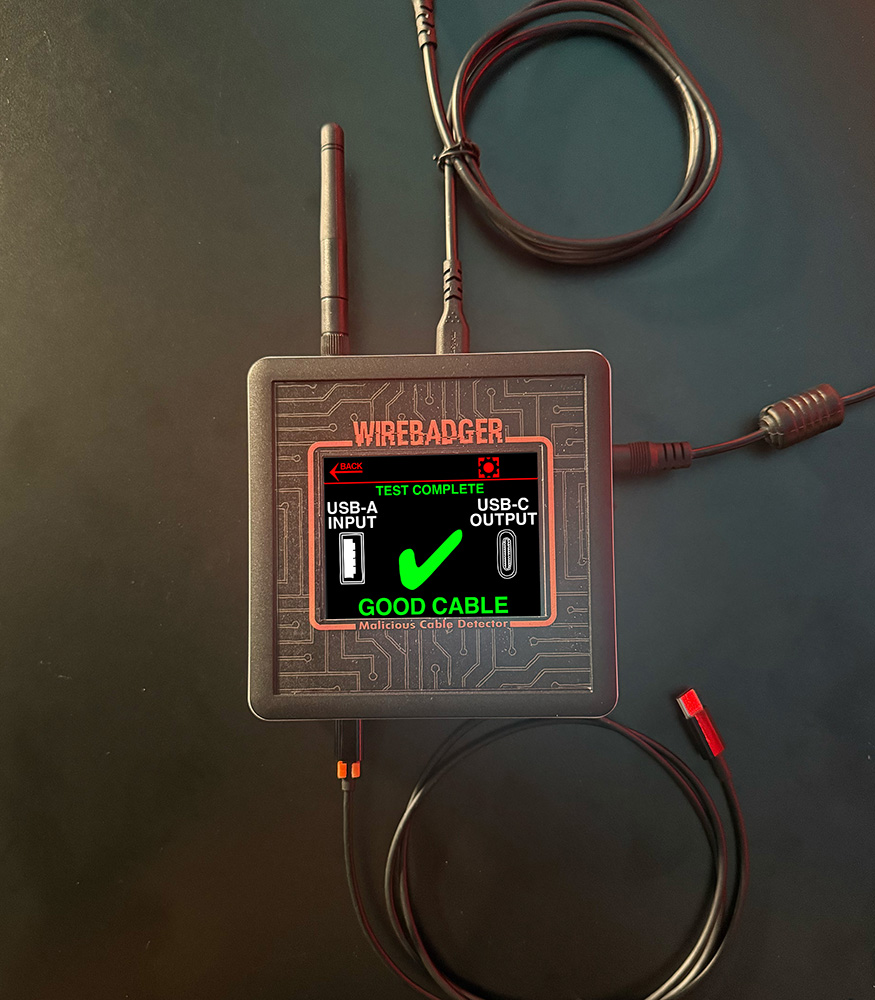
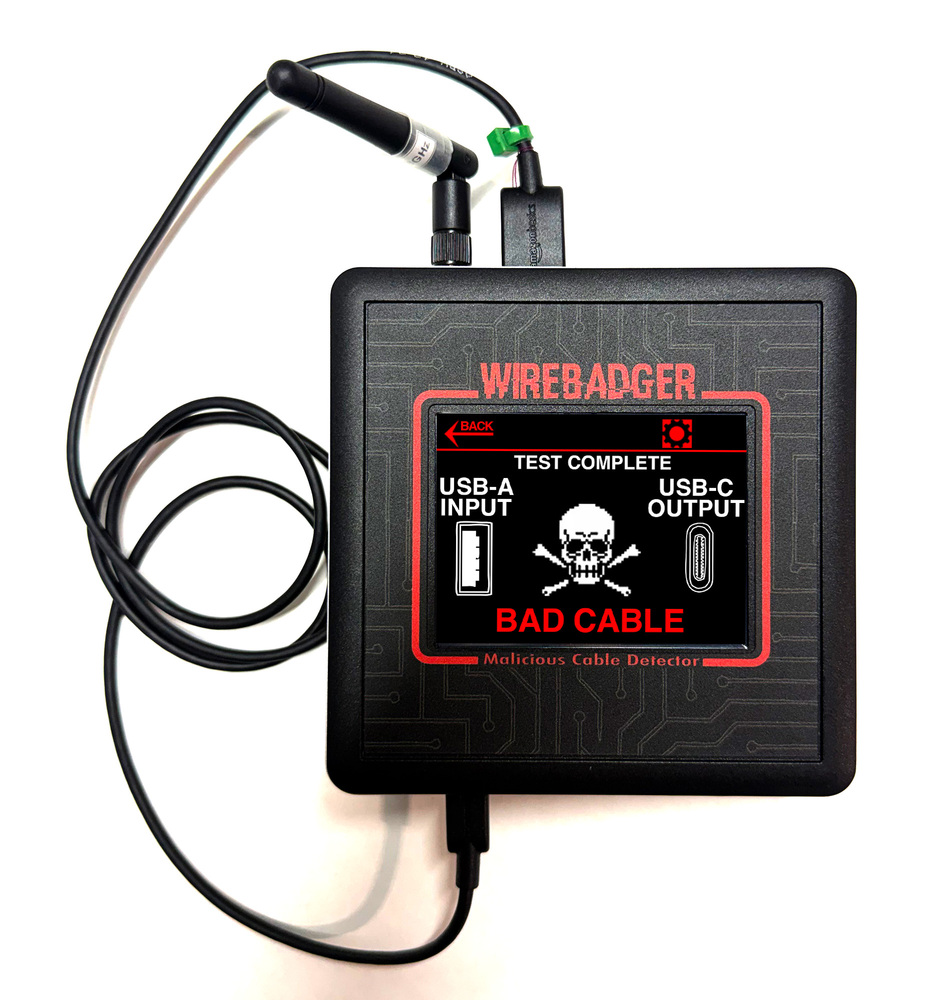
Plug both ends of your USB or Lightning cable into WireBadger for instant security analysis
Wireless Detection
Detects hidden Bluetooth and Wi-Fi hotspots embedded within cables.
All Cables
Detects malicious cables in the most popular forms including USB-A, USB-B, USB-C, USB-Mini, USB-Micro and Lightning.
Easy To Use
Simple operation for anyone including security personnel, white hats, grey hats and pen testers.
Voice Alerts
Clear audio alerts for good and bad cable detections.
Technical Specifications
| INPUT CABLE SUPPORT | USB-A USB-B USB-C USB-Mini USB-Micro Lightning |
|---|---|
| OUTPUT CABLE SUPPORT | USB-C USB-A |
| WIRELESS SUPPORT | Wi-Fi Bluetooth |
| TESTS PERFORMED | Wi-Fi Cable integrity Bluetooth (scans for any active embedded BT) Wi-Fi (scans for implanted hotspots) |
| POWER REQUIREMENTS | Wi-Fi DC transformer (supplied) |
| INTERFACE | Wi-Fi 320 x 240 resistive LCD touchscreen |
| ALERTS | Wi-Fi Visual and audible (voice and tones) alerts via speaker |
| UNIT DIMENSIONS | Wi-Fi 120 x 70 x 30mm |
| WEIGHT | Wi-Fi 10 ounces (283 grams) |
| OPERATING TEMPERATURE | Wi-Fi 32º – 122º F (0º – 50º C) |
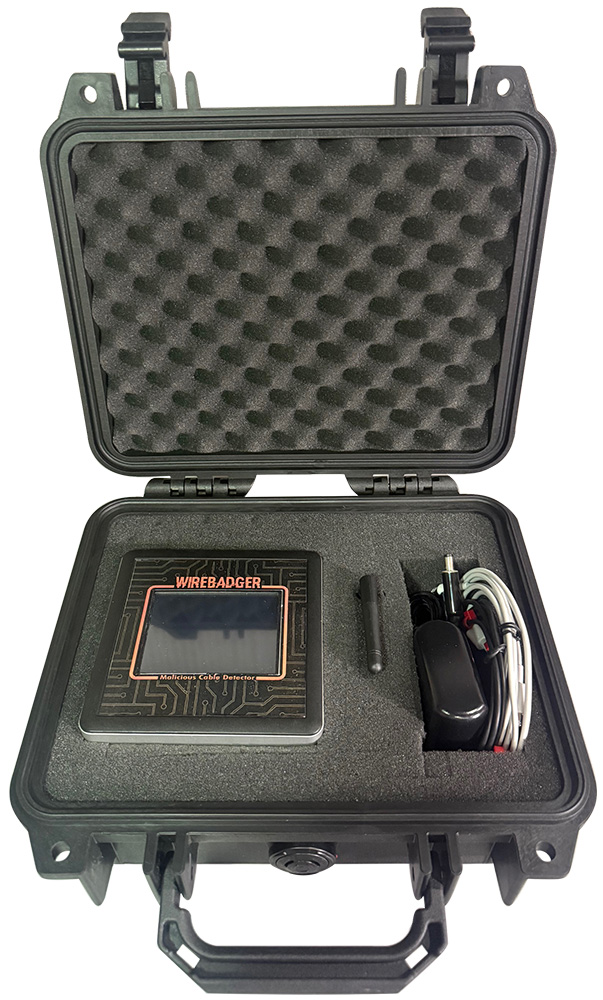
| INCLUDED ACCESSORIES | Wi-Fi (1) Omni-directional SMA antenna, power adapter |
| OPTIONAL ACCESSORIES | Test kit includes (3) Good USB cables + (3) bad USB cables |
What cables can I test?
WireBadger tests the most popular USB configurations such as USB-A, USB-B, USB-C, USB-Micro, USB-Mini and Lightning cables.
Why are there inputs and outputs?
In order to test cables for subtle current draws (indicating malicious behavior), both ends of the cable must be connected to WireBadger. The inputs include USB-A, USB-B, USB-C, USB-Micro, USB-Mini and Lightning cables. The outputs include USB-C and USB-A. This covers every popular combination on the market.
Does WireBadger detect malicious wireless hotspots?
Yes. Many malicious cables actually contain tiny, wireless hotspots that can be triggered remotely to deploy malware into the devices that the cable is plugged into.